Advanced Stem Separation
High Quality stem separating of Vocals (male and female), Drumbs, Bass, Guitar, Piano, and other instruments.
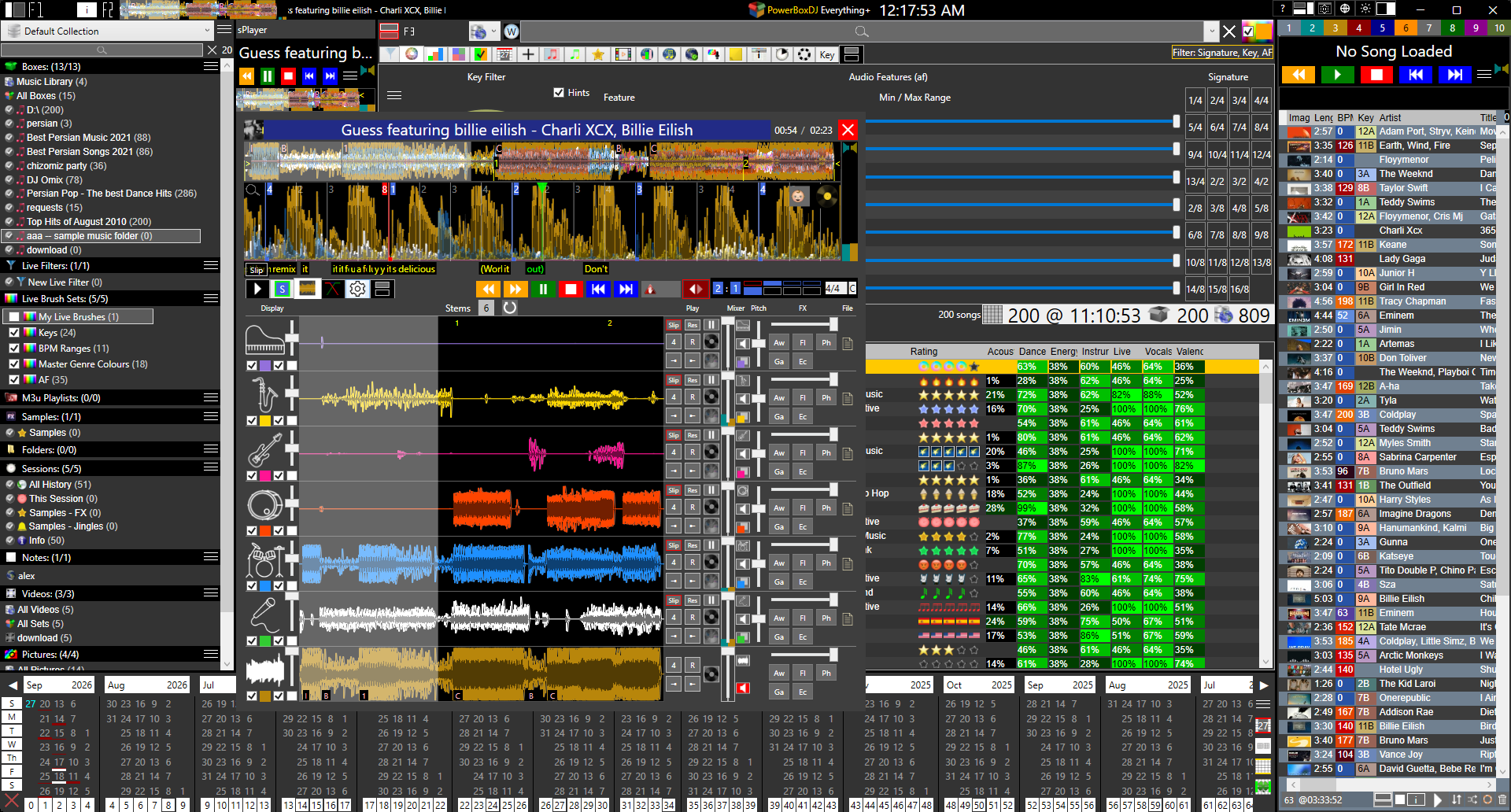
On 4 November 2019, music subscription Deezer released Spleeter. It is a Python library on TensorFlow, and this is Stems Version 1. The models shipped that month are still the CPU counts: 2 stems is vocals and others, 4 stems is vocals, drums, bass, and others, and 5 stems adds piano. It opened a new way to hear a record and to change it. The main objective was to remove the vocals.
Meta, still publishing the research as Facebook, built a different model called Demucs. It is Python on PyTorch, and the GPU is what makes it fast enough to run live. That live path is Stems Version 2. A 2-stem split, vocals against the rest, was added on 24 February 2022. On 7 December 2022 Hybrid Transformer Demucs became the default, and that release added the 6-stem model: vocals, drums, bass, guitar, piano, and others. The Demucs authors said the guitar stem is usable and the piano stem still leaks.
Deezer and Meta are two completely different companies. Each model has its own outputs. In the Demucs authors’ comparison, Spleeter scores 5.9 dB SDR and fine-tuned Hybrid Transformer Demucs scores 9.0 dB, so the Demucs stems are cleaner. PowerBox DJ offers both models. Another model takes the vocal output and separates it into male and female. This feature is often ignored in other softwares. PowerBox DJ offers it as well. It is especially useful when the DJ needs the vocal parts separated.
| Spleeter · CPU | Demucs · GPU | |
|---|---|---|
| 2 stems | Vocals, Others | Vocals, Others |
| 4 stems | Vocals, Drums, Bass, Others | Vocals, Drums, Bass, Others |
| 5 stems | Vocals, Drums, Bass, Piano, Others | |
| 6 stems | Vocals, Drums, Bass, Guitar, Piano, Others | |
| Speed | Fast on CPU. Deezer measured 4 stems at about 100 times real time on a GPU. | Live on GPU. The same model on CPU is much slower. |
| Score | 5.9 dB SDR | 9.0 dB SDR |
SDR is the separation score in that published table. Higher is a cleaner stem. The 9.0 dB figure is fine-tuned Hybrid Transformer Demucs.
2 stems is the vocal and everything else. Mute the vocal and the song is an instrumental. Solo the vocal and the singer is alone. AI Words to text uses this count, because the words only need the vocal stem, and high quality 2 stems is the fast split.
4 stems is vocals, drums, bass, and the rest. The CPU model and the GPU model both make this split. Drop the vocal and keep the kick and the bass for a dinner set, or solo the drums and loop them under the next record.
5 stems is the CPU model only. It adds piano: vocals, drums, bass, piano, and the rest. Use it when the piano has to sit on its own and the song can take a moment to split.
6 stems is the GPU model only. It adds guitar and piano: vocals, drums, bass, guitar, piano, and the rest. A first dance does not need six. A mashup, an edit, or a request that asks for one part does. The guitar stem is usable. The piano stem on this model still leaks, so the CPU 5-stem split is the cleaner piano.
Each stem is a player in Full DJ Deck. It has its own wave, volume, mute, solo, key, and audio effects. Clone the part, then seek, slip, loop, or scratch just that part while the rest of the song keeps playing. Reorder the waves, brush them, and read the structure on the part the same way you read it on the whole song.
Clone copies a stem so you can work the copy and leave the original running. Pitch the clone. FX the clone. Loop the clone. The rest of the track stays where it was. That is how you stack a vocal, or double a drum hit, without a second deck loaded with the same file.
Per stem you also get mute, solo, volume, and key (pitch shift). Reorder the stems. Set opacity. Brush the wave. Structure analysis sits on the part, not only on the whole song. Drag a stem to a third-party program if the next move is not inside the player.
Stem Seek: select one stem and temporarily seek forward to preview the song. The rest can hold. You are not scrubbing the whole mix to hear where the vocal comes back. You pick the part, you seek it, you hear it, you drop back. That is the difference between stems as mute buttons and stems as a player.
Seek, slip, resume, play, pause, loop, reloop, scratch: the same verbs as the full track, on the part you selected. A mobile DJ uses that when a request is half a song you do not remember. Seek the vocal. Confirm it. Play it.
Audio effects sit on the stem, not only on the master. Echo the vocal. Leave the drums dry. Filter the rest. Matrix device output FX is the Full DJ Deck name for that path. Clone plus FX is the live edit: a copy of the vocal with the effect, the original still under it.
A four-stem mute is one feature. A six-stem player with clone, seek, and FX is another. It lives in Full DJ Deck, next to loops, cues, auto cues, slip, and beat match. Full DJ Deck is the page of parts.
Related
 Download Now